Book Score · the free book discovery audit
Can readers find your book?
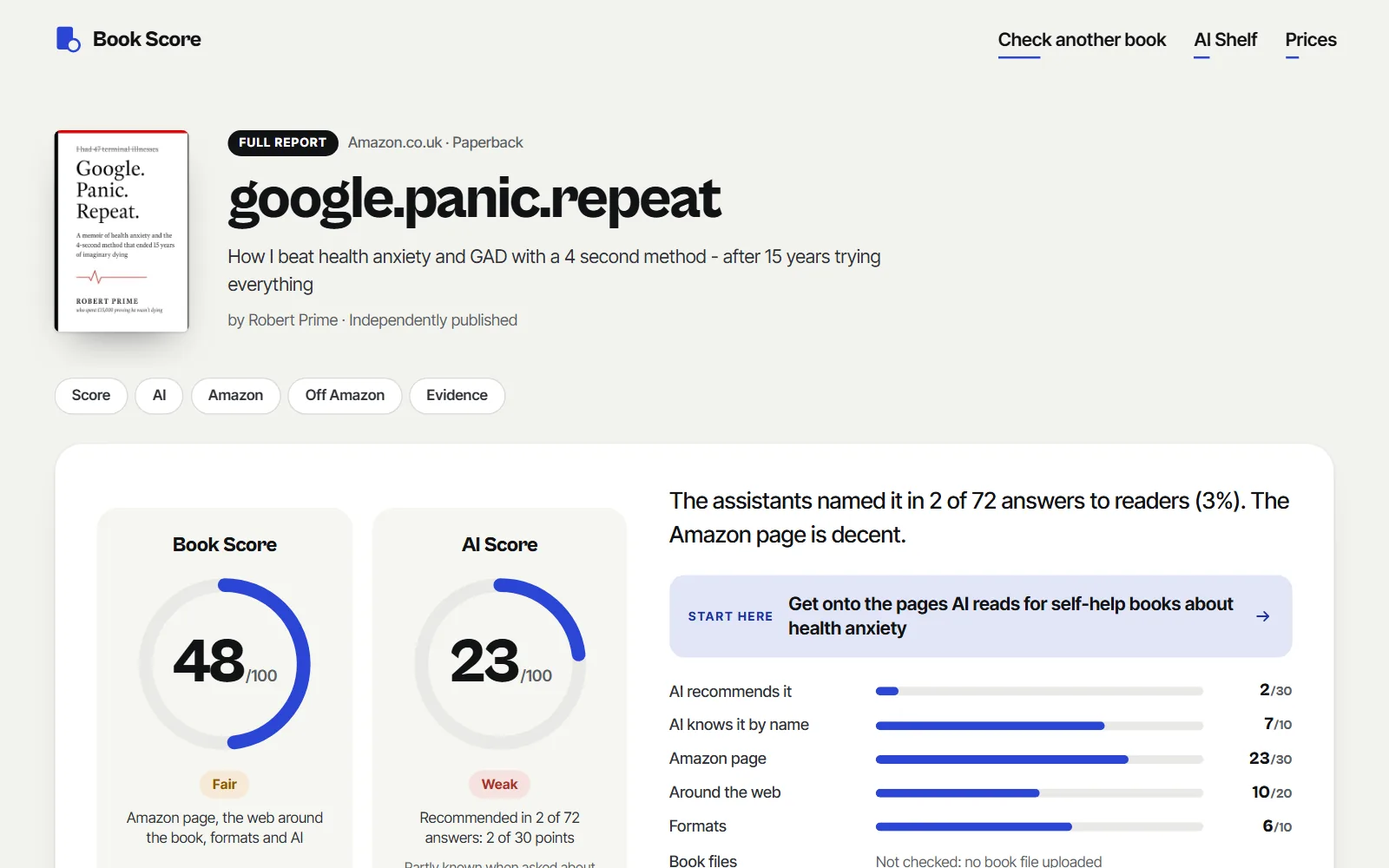
Readers find books in three places: on Amazon, by asking AI assistants what to read, and on the sites they trust. Paste your Amazon link and Book Score checks all three in about a minute, then gives you a score out of 100 and the three fixes worth most.
No link to hand? See a real report
What it checks · one score out of 100
Every place a reader finds your book.
The score comes from fixed rules: the same answers and the same page always give the same score. Parts we can't check are left out, never counted against you.
- 40 points · what AI assistants say
Does AI recommend your book?
We ask ChatGPT, Claude and Gemini what a reader would ask, without naming your book, and record whether it comes up and who is named instead. ChatGPT and Claude search the web live; Gemini answers from what it already knows. 30 points for being recommended, 10 for being known when asked by name.
- 30 points · your Amazon page
Is the page ready when they arrive?
Title words, description, A+ panels, ratings and what reviews say, categories, the cover at thumbnail size, price. Read the way a shopper reads it, and checked against Amazon's own rules from KDP's help pages.
- 20 points · around the web
Can AI find you anywhere else?
Goodreads, Wikidata, Wikipedia, YouTube, Reddit, your own site, and the sites AI cites most for your genre.
- 10 points · formats
How many ways in are there?
Kindle, paperback, hardcover, audiobook. Each one is another way to be found.
The full report · £49 once, per book
Then we write the fixes.
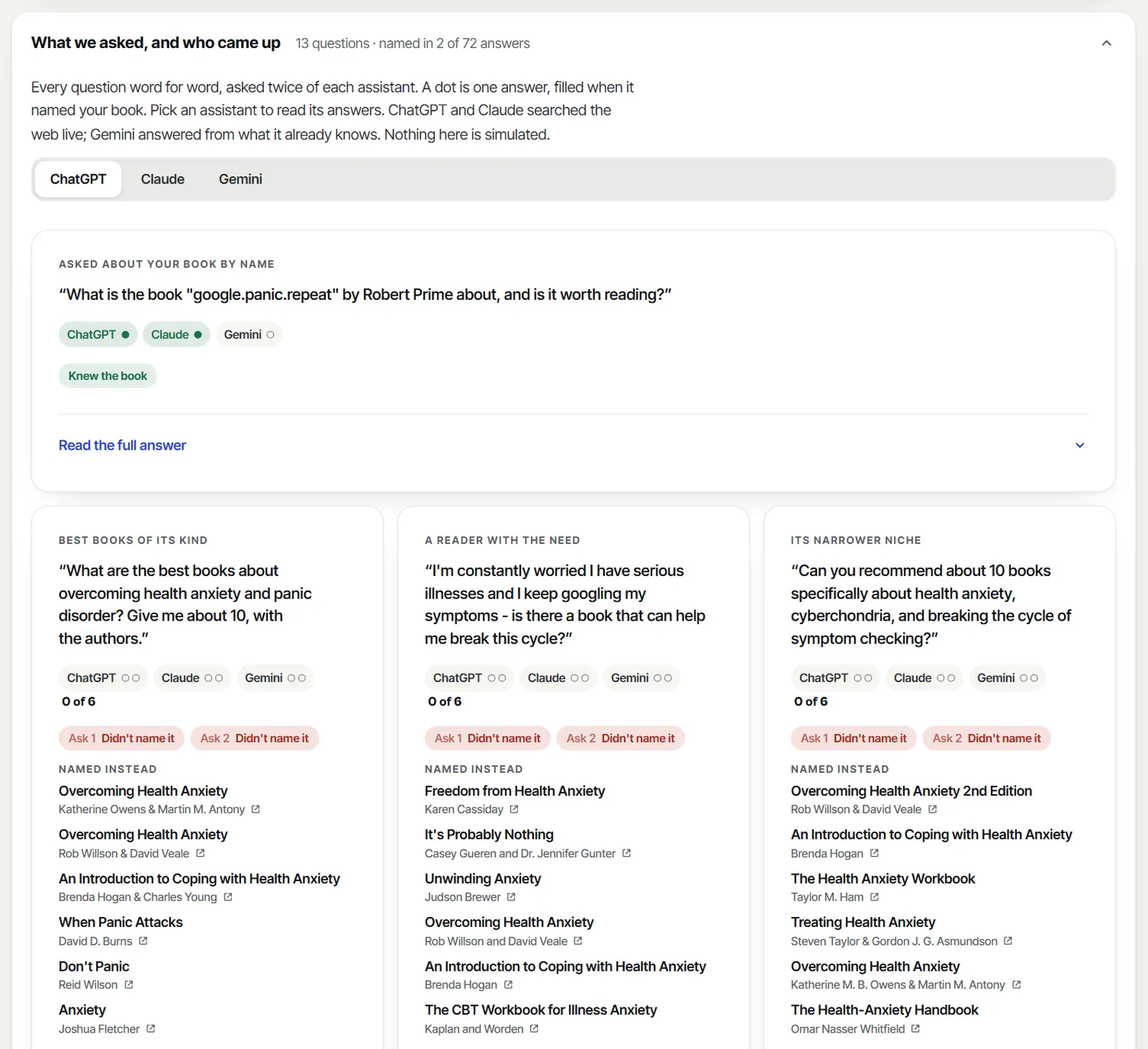
The full report is set out the way readers find books, in three parts: what the AI assistants say (12 reader questions, asked twice of each assistant: 72 real answers), your Amazon page, and everywhere off Amazon. Every fix opens in place, with the steps, where to click, and the words already written for you to paste.
What the AI assistants said
Every question word for word, and who came up in each answer. How often each assistant named your book across 72 answers, and the range the true figure probably sits in.
Start here, then tick them off
Each fix ranked by the points it can add for the time it takes. Open one and it shows the steps, the button to the page where you make the change, and what to paste.
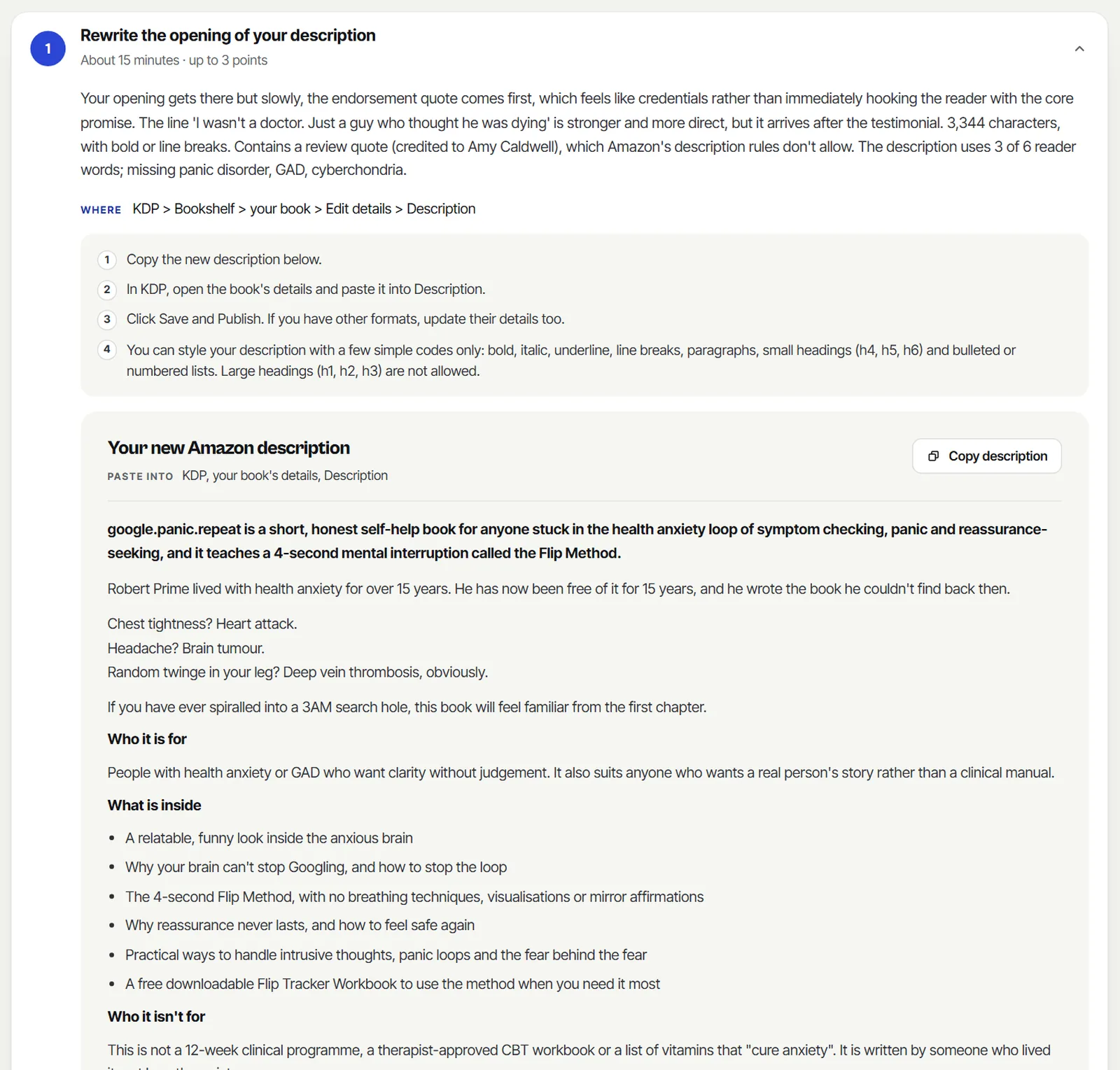
Your Amazon page, line by line
Every check on the page with what we saw. Each Amazon fix opens with its new words inside: description, keywords, categories, A+ panels and bio.
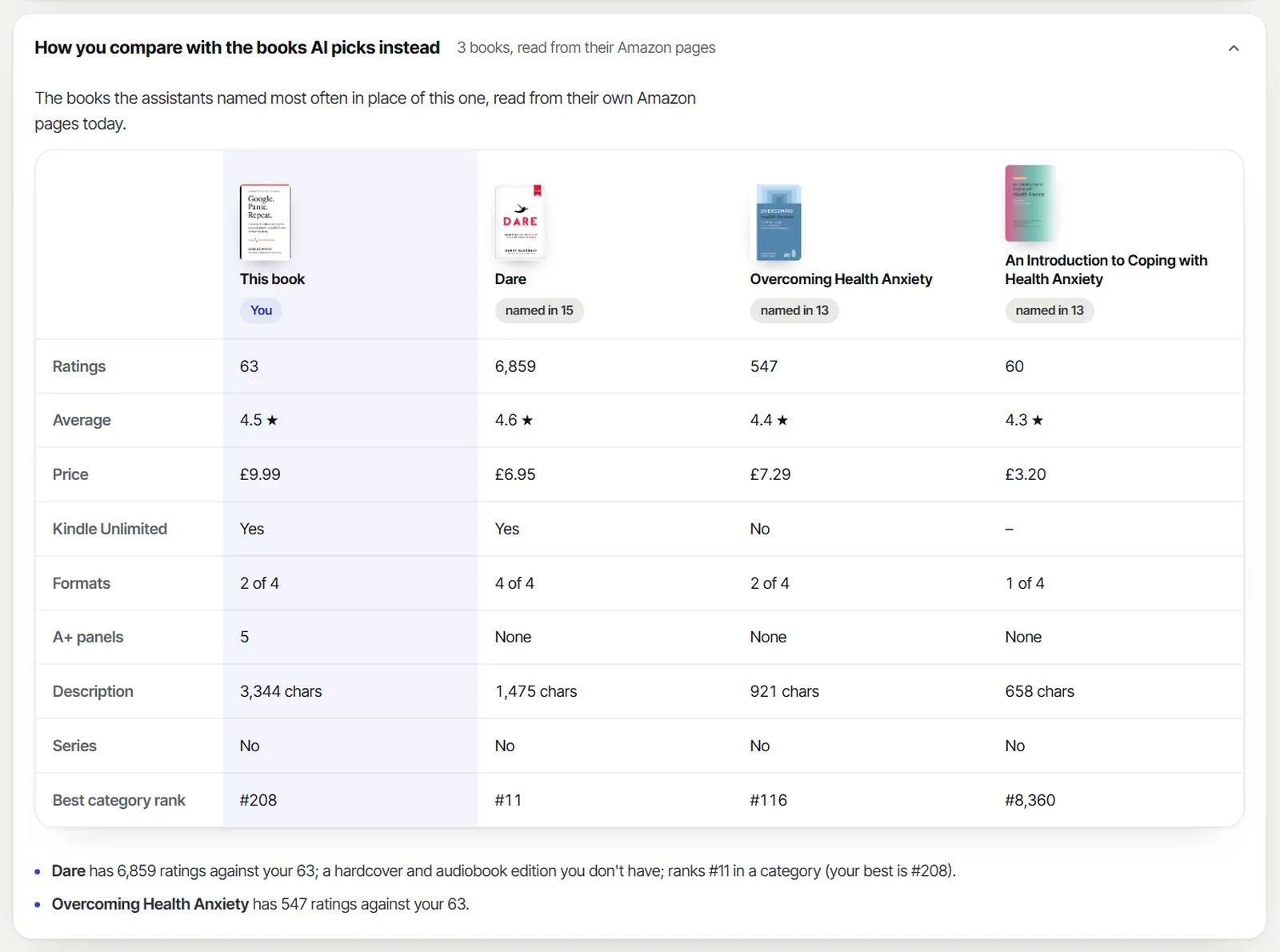
The books AI picks instead
Side by side with the books the assistants name most often in your place: ratings, price, formats, A+ panels, rank.
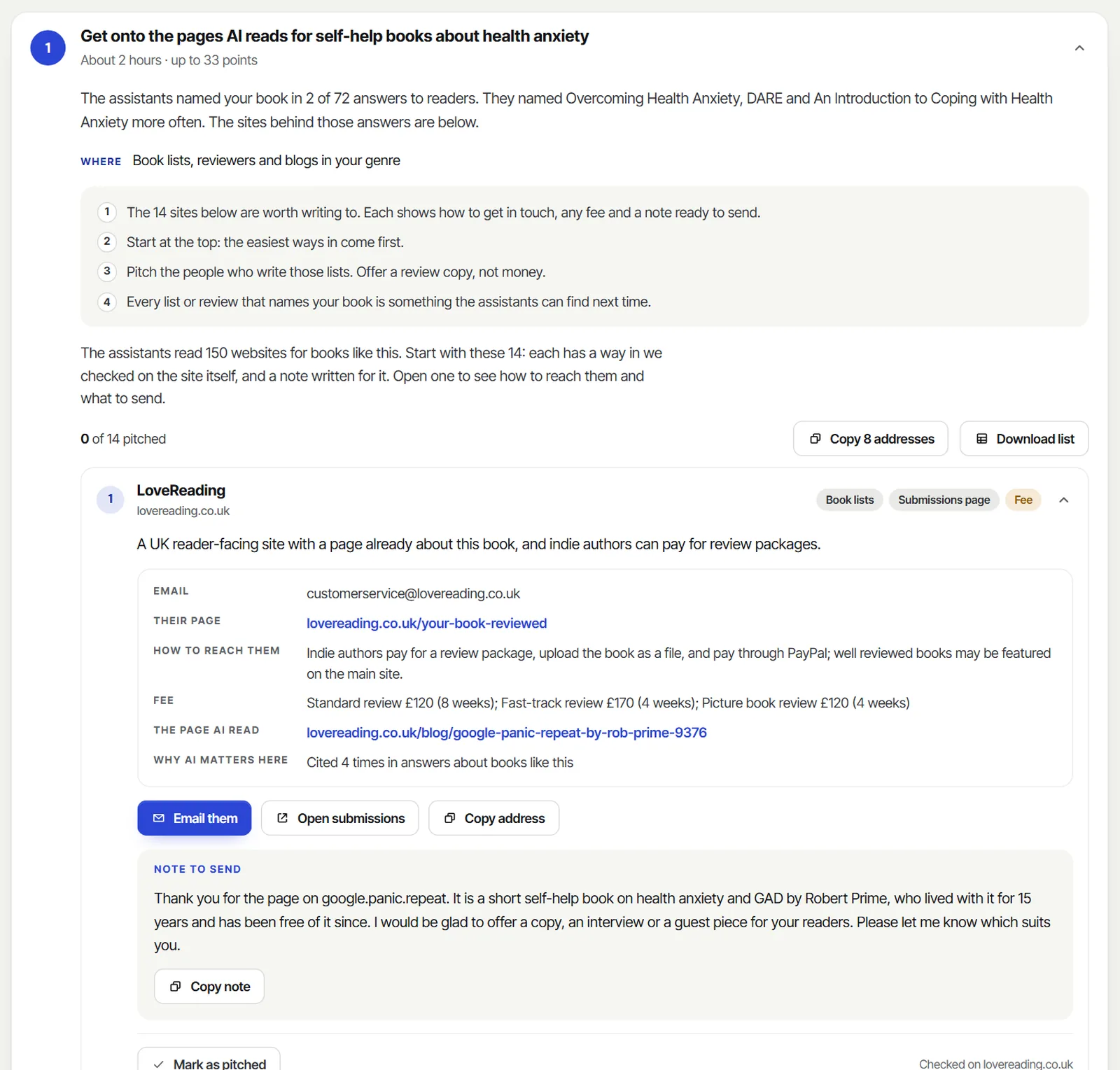
Off Amazon: who to contact, and what to send
The sites readers and AI trust for your genre, each with the way in we checked on the site itself, any fee as the site states it, and a note written for you. Plus Goodreads, Wikidata and your own website.
Every word written for you
A new description inside Amazon's rules, seven keywords and three categories, five A+ panels, your bio short and long, and the book code for your website.
A real report, on a real book
What you get, page by page.
These are from the full report on google.panic.repeat by Robert Prime, who runs publishing.co.uk. It's his own book, so you can open every part of it. Each part opens and closes, so the page stays short. Download it as a PDF or a spreadsheet when you're done.
The AI Shelf · updated every week
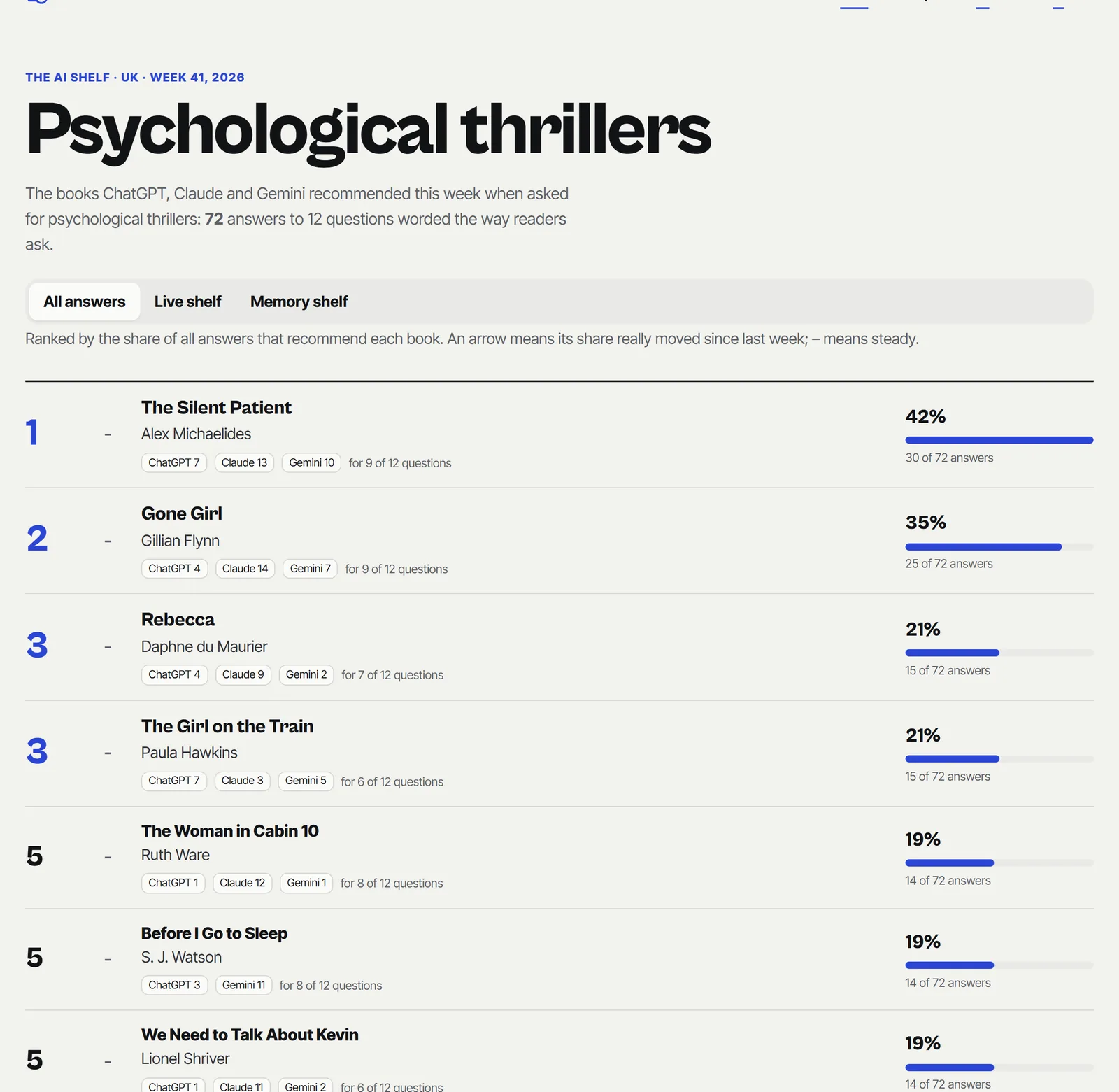
The books AI is recommending right now.
Every week we ask ChatGPT, Claude and Gemini the same 12 reader questions in each genre, twice each, and chart the books they name. A list is published only when every assistant answered. Your full report asks the same kind of questions, written for your book's own niche.
Prices · author prices include VAT
A free score for every book. Pay for the depth.
Book Score
Your score out of 100 across Amazon, the AI assistants and the web, what ChatGPT, Claude and Gemini said, and your first three fixes
Full report and fix pack
Once, per book: 72 real AI answers, every site worth writing to, rivals, your Amazon page line by line, every fix written
Report and Watch
One book for a year: a check every week, the full report every month, an email when an assistant starts or stops recommending you
Backlist, a month
Up to 10 books checked every week, a full report for each every quarter
Done for you
The full report, then we make the Amazon, website, Wikidata and Goodreads changes with you and pitch the top 20 places, with your OK
Publishers and agencies, a month + VAT
50 titles and up, checked every week; catalogue check from £995 once; reports under your own name for agencies
AI Discoverability for Authors (course)
Learn the work yourself: 39 lessons, 14 templates, a 90-day action plan
How it stays honest
Real answers. Fixed rules. No promises.
Never simulated
Every answer is a real one from ChatGPT, Claude or Gemini. We never present a simulated assistant as a real one.
Never invented
The fixes we write never invent praise, awards or numbers. Gaps are marked, not filled.
Never logged in
We read your public Amazon page. We never log in to your Amazon or KDP account.
A diagnosis
A score tells you where you stand and what to fix first. It is not a promise of sales.
About a minute. Free. No sign-up.
Find out how readers find your book on Amazon, in ChatGPT, Claude and Gemini, and across the web, and the three fixes worth most.