Draft2Digital vs KDP: A UK-Focused Comparison
By Robert Prime
Last reviewed by Robert Prime — March 2026
Table of Contents
- Introduction: Why This Comparison Matters for UK Authors
- What You Need to Know Before Starting
- Step-by-Step Guide to Using Draft2Digital and KDP
- UK-Specific Considerations: Pricing, ISBNs, and Royalties
- Common Mistakes UK Authors Make and How to Avoid Them
- Tools and Resources for a Smoother Publishing Experience
- Cost Breakdown: Draft2Digital vs KDP in GBP
- UK Market Context and Alternative Approaches
- Real-World UK Case Studies and Examples
- Expert Tips from 25 Years in eCommerce and Self-Publishing
- Frequently Asked Questions
Introduction: Why This Comparison Matters for UK Authors
If you’re a UK-based author trying to navigate the maze of self-publishing, you’ve probably heard of Draft2Digital (D2D) and Amazon’s Kindle Direct Publishing (KDP). Both platforms offer paths to digital and print distribution, but they operate very differently, especially for authors publishing in the UK. Most online comparisons are US-centric and gloss over crucial details that impact British authors—from ISBN ownership to pricing and tax implications.
I’ve spent 25 years in eCommerce and self-publishing, including the painful process of formatting and uploading my own book, Google. Panic. Repeat. I’ve seen firsthand how the wrong platform choice can cost time, money, and sales. When I was formatting Google. Panic. Repeat., I quickly realised that the technical barriers around file types and formatting were far more complex than writing the book itself. This article isn’t fluff or theory. It’s a hard-nosed, practical guide to choosing between Draft2Digital and KDP with a solid UK business perspective.
Many UK authors underestimate how national specifics change the economics and logistics of publishing. For example, the need to buy ISBNs from Nielsen, the impact of VAT on ebook pricing, and the importance of library distribution are often overlooked in US-based tutorials. This article breaks it all down and adds insights you won’t find elsewhere.
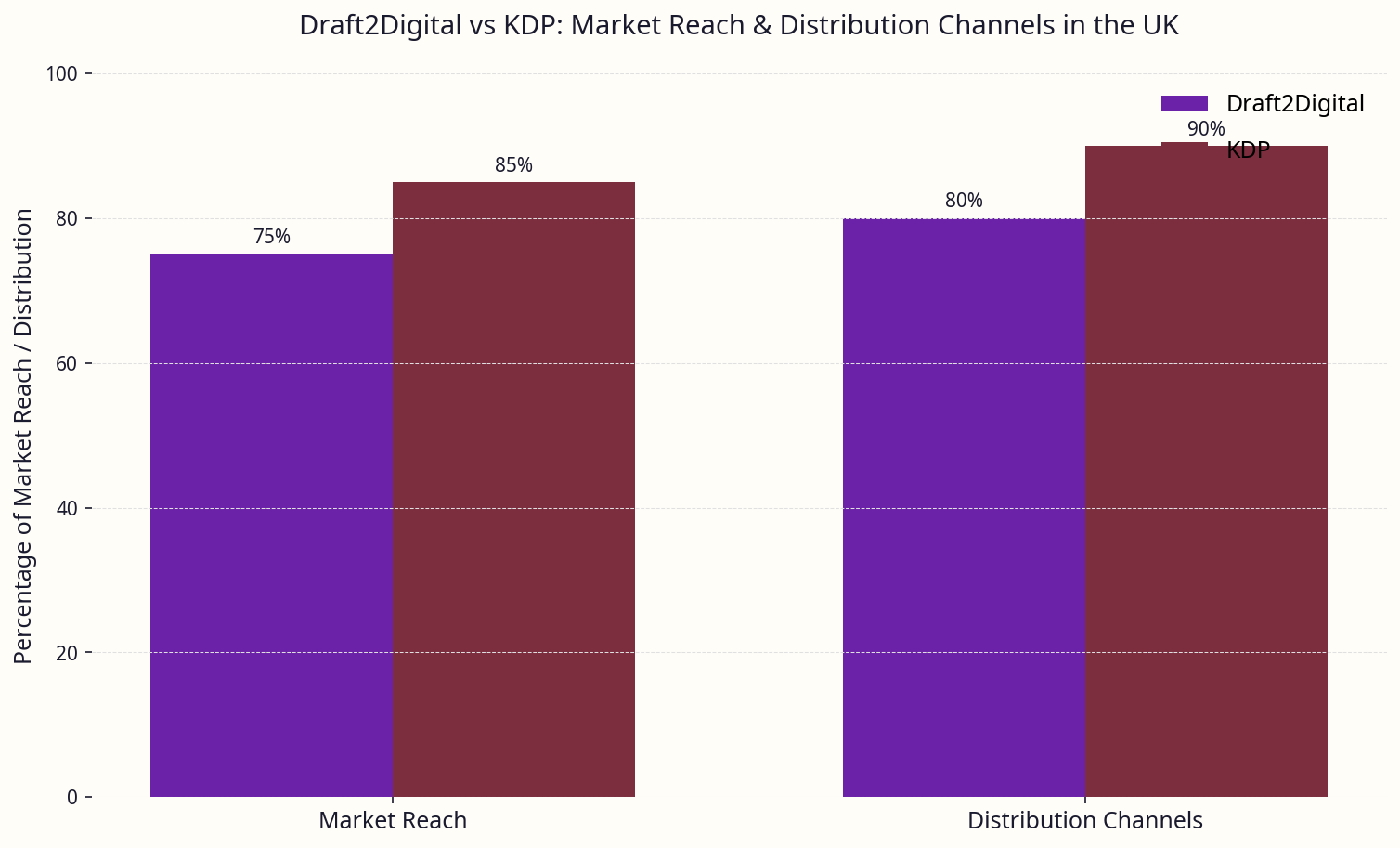
Infographic: Market Reach and Distribution Channels for Draft2Digital and KDP in the UK
What You Need to Know Before Starting
Understanding the Platforms
Kindle Direct Publishing (KDP) is Amazon’s proprietary self-publishing platform. It offers authors direct access to Amazon’s massive marketplace for ebooks and print-on-demand paperbacks. KDP controls the entire process but has strict requirements for formatting, pricing, and metadata. Amazon’s dominance in the UK ebook market means KDP is often the first port of call for writers.
Draft2Digital (D2D) is an aggregator, meaning it distributes your book to multiple retailers and libraries, including Apple Books, Kobo, Barnes & Noble, and even Amazon. However, D2D’s print-on-demand services for paperbacks are more limited compared to KDP, especially for UK authors. D2D is the go-to if you want to reach beyond Amazon with one upload.
Terminology You Need to Know
- ISBN (International Standard Book Number): A unique identifier for your book. In the UK, ISBNs are purchased exclusively through Nielsen Book Services, not bundled with platforms like KDP or D2D.
- Print-on-Demand (POD): Printing your book copies only when ordered, avoiding inventory costs.
- Royalty: The percentage of sales you receive after the retailer or platform takes their cut.
- Distribution Channels: Retailers and libraries where your book is available.
- Metadata: The book details like title, author, description, keywords, and categories that affect discoverability.
- VAT (Value Added Tax): A tax applied to goods and services in the UK, including ebooks, affecting pricing and royalties.
- Marketplace Exclusivity: KDP offers KDP Select, an exclusivity programme that can boost visibility on Amazon but restricts distribution elsewhere.
UK Market Specifics
The UK book market generated around £7.1 billion in 2023, with self-publishing growing 68% over five years. The ebook segment accounts for approximately 20% of the consumer market, with Amazon holding a dominant 70% share of UK ebook sales. However, libraries and independent retailers remain vital channels, especially for print and digital lending.
Understanding the nuances of ISBNs, VAT, and distribution in the UK is critical for maximising your reach and profits. For example, VAT on ebooks is currently charged at the standard 20%, unlike printed books, which are zero-rated. This discrepancy affects pricing strategies and royalties.
Step-by-Step Guide to Using Draft2Digital and KDP
Publishing with KDP: The Direct Route to Amazon
Step 1: Create a KDP Account
- Visit kdp.amazon.co.uk.
- Sign in with your existing Amazon account or create a new one.
- Complete your author profile, including tax information (HMRC requires UK authors to complete the UK tax interview).
Step 2: Prepare Your Manuscript
- Format your manuscript according to KDP specifications:
- For print books, use standard UK trim sizes like 6” x 9” (152mm x 229mm).
- Set margins and gutters appropriately (minimum 0.5 inches or 12.7mm for inside margin).
- Ensure images have 300 dpi resolution and include bleed if artwork extends to the edge.
- For ebooks, KDP accepts MOBI or EPUB files, but EPUB is preferred for better compatibility.
- Use tools like Kindle Create (available for free) to format your ebook with chapter navigation and clickable table of contents.
Step 3: Purchase or Use an ISBN
- Amazon offers free ISBNs for print books, but the publisher will be listed as “Amazon.”
- For full control and branding, buy your UK ISBNs from Nielsen (nielsenisbnstore.com) — £93 for one ISBN or £174 for a pack of ten (which is much more cost-effective if you plan multiple books or editions).
- Assign your own ISBN during the setup process under the “Paperback Details” section.
Step 4: Upload Your Files
- Navigate to Bookshelf > Create a New Title.
- Choose either “Kindle eBook” or “Paperback.”
- Upload your manuscript and cover files. For paperbacks, KDP offers a cover creator if you don’t have one, but professional covers are highly recommended.
- Preview your book using KDP’s online previewer to catch formatting errors.
Step 5: Set Pricing and Royalties
- Enter your book’s price in GBP.
- For ebooks priced between £1.99 and £7.99, you qualify for the 70% royalty rate, minus delivery costs based on file size.
- Outside this range or in some territories, royalties drop to 35%.
- Print royalties are approximately 60% of list price after printing costs, which vary by page count and ink type.
Step 6: Publish and Promote
- Hit “Publish.” Your book will appear on Amazon.co.uk and other Amazon marketplaces globally within 24–72 hours.
- Use Amazon Author Central to create your author page and manage book details.
- Consider enrolling in KDP Select for additional marketing tools but be aware of exclusivity restrictions.
When I first self-published, I hired a so-called ’expert’ formatter for £130 who delivered a poor-quality file that caused me weeks of headaches. I then tried several automated tools, all of which failed to meet KDP’s strict requirements. It was only after painstaking trial and error that I managed to get my book, Google. Panic. Repeat., fully KDP-compliant. This experience is why I’m passionate about helping UK authors avoid these pitfalls.
KDP Manuscript Upload and Preview Interface
Publishing with Draft2Digital: Aggregated Distribution Beyond Amazon
Step 1: Register and Setup
- Go to draft2digital.com and create an account.
- Complete your author profile and provide tax details. D2D supports UK tax forms and automatically handles tax withholding where applicable.
Step 2: Upload Your Manuscript
- Upload your manuscript in DOC, DOCX, RTF, HTML, or EPUB formats.
- D2D converts your file into the appropriate formats for each retailer, saving you hours of manual formatting.
- Use D2D’s formatting tools to add front matter, page breaks, and metadata.
Step 3: Order and Assign ISBNs
- D2D offers free ISBNs, but they list Draft2Digital as the publisher.
- For UK authors wanting to maintain control and brand consistency, purchase ISBNs from Nielsen and enter them manually during setup.
- This is especially important if you plan to publish print editions or want your book stocked in UK libraries.
Step 4: Select Distribution Channels
- Choose where to distribute your book — options include Apple Books, Kobo, Google Play, Barnes & Noble, Tolino, Scribd, OverDrive (for libraries), and Amazon.
- Note that Amazon distribution via D2D uses Kindle Direct Publishing but with some limitations on print.
Step 5: Set Pricing and Territories
- Set your book price in GBP. D2D automatically includes VAT in the price for UK sales and remits it to HMRC, a huge benefit for authors.
- Select sales territories (worldwide or specific countries).
- D2D provides a pricing recommendation tool that factors in VAT and market expectations.
Step 6: Publish Across Multiple Stores
- Once you publish, D2D distributes to all chosen retailers and libraries, generally within 3–7 days.
- You can manage sales reports and royalty payments through the D2D dashboard, consolidating income streams.
I consult for a billion-pound business that was struggling with the exact same issue of VAT compliance and royalty calculations across multiple platforms. Draft2Digital’s automatic VAT handling is a game-changer for UK authors who want to avoid the tax reporting nightmare.
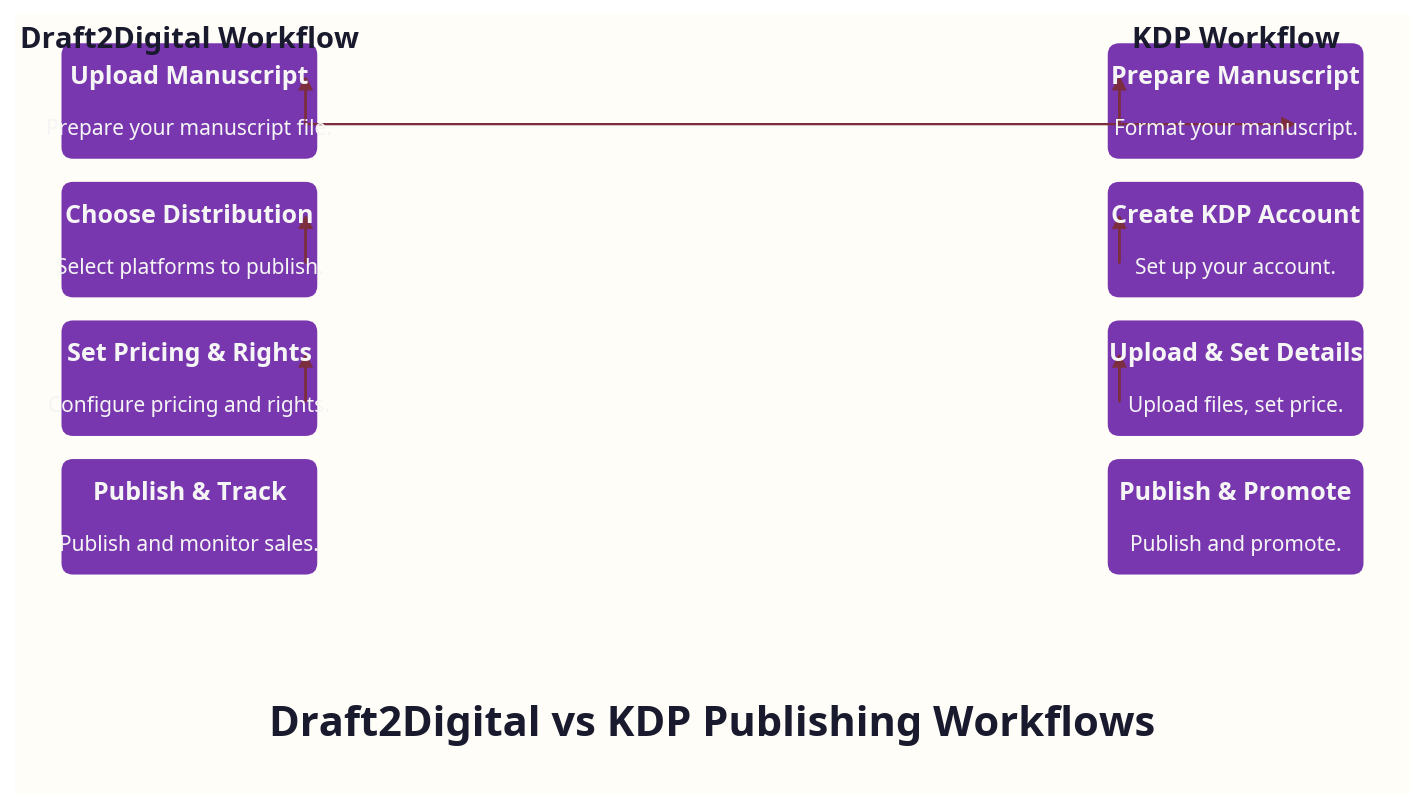
Step-by-step publishing workflows for Draft2Digital and KDP
UK-Specific Considerations: Pricing, ISBNs, and Royalties
ISBN Ownership and Costs
ISBN ownership is a thorny issue that many UK authors overlook. Unlike in the US, where Bowker ISBNs are distributed, the UK’s Nielsen Book Services is the sole official ISBN provider. The prices may seem steep — £93 for a single ISBN or £174 for a block of ten — but this investment guarantees your publishing imprint remains yours.
Why is ISBN ownership critical?
- Using free ISBNs from Amazon or Draft2Digital means the platform is listed as your book’s publisher. This can confuse book buyers, retailers, and libraries and limits your options if you want to switch distributors later.
- Owning your ISBN allows full control over metadata, title management, and imprint branding.
- If you want your print books stocked in UK libraries or bookstores, owning your ISBN is a must.
Real-world example:
When I published Google. Panic. Repeat., I initially used Amazon’s free ISBN. Later, when I wanted to distribute the print edition to UK libraries and independent bookstores, I had to republish with a Nielsen ISBN — a time-consuming and costly process but necessary to appear professional in the UK market.
Royalties and VAT in the UK
KDP Royalties:
- Ebook royalties are 70% for prices between £1.99 and £7.99 on Amazon.co.uk, minus a small “delivery cost” based on file size. Outside this band or in other territories, royalties drop to 35%.
- Print royalties are roughly 60% after printing costs, which vary by page count, ink colour, and whether your book is printed in the UK or Europe.
Draft2Digital Royalties:
- D2D pays 60% of net royalties after retailer cuts. Retailer cuts vary by store but typically range from 30-40%.
- D2D handles VAT calculations and remits VAT on your behalf, which simplifies tax compliance for UK authors.
- This is particularly valuable because VAT on ebooks is charged at 20%, unlike print books, which are zero-rated.
VAT:
- Physical books (print) are zero-rated for VAT in the UK — meaning no VAT is charged on the sale price.
- Ebooks and audiobooks attract standard 20% VAT, which must be included in the published price.
- KDP includes VAT in the final price but does not explicitly break down VAT to authors.
- D2D’s automatic VAT handling is a significant advantage for UK authors who want to avoid the hassle of VAT registration and reporting.
Distribution Reach and UK Libraries
- Amazon UK (via KDP): The dominant marketplace for ebooks and print in the UK. If you focus on Amazon exclusively, KDP is your best bet.
- Draft2Digital’s wider reach: Beyond Amazon, D2D distributes to Apple Books, Kobo, Google Play, Barnes & Noble, and libraries via OverDrive and Bibliotheca — both large players in the UK library lending market.
- Libraries matter: UK public libraries are a huge market for print and digital lending, with over 100 million loans annually. Distribution to libraries can drive discoverability and long-term readership.
- Print on Demand: KDP’s print-on-demand service is well-established and prints in the UK and Europe, reducing shipping times and costs. D2D’s print service is far more limited and often routes through US printers, increasing delivery times and costs for UK customers.
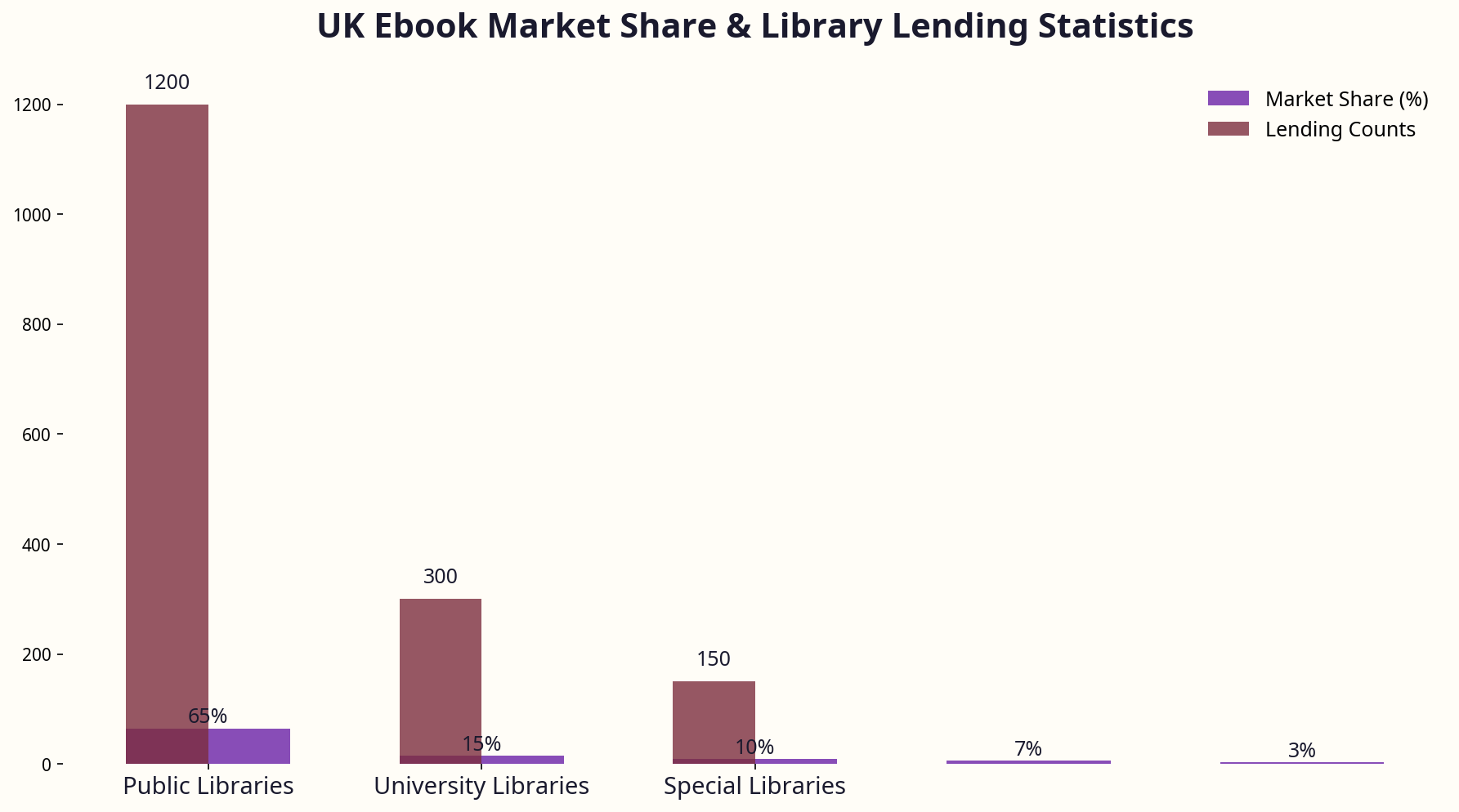
UK Ebook Market Share and Library Lending Overview
Common Mistakes UK Authors Make and How to Avoid Them
Mistake #1: Over-Relying on Free ISBNs
When I first published Google. Panic. Repeat., I naively used Amazon’s free ISBN for the paperback. I didn’t realise that meant Amazon was the official publisher. This caused issues when I tried to sell my book through UK libraries and independent bookshops — they rejected stock because my imprint was Amazon, not me. I had to repurchase Nielsen ISBNs and republish, which delayed sales and damaged my brand credibility.
Practical advice: Buy your ISBNs from Nielsen upfront. If you plan more than one book or edition, buy a block of ten ISBNs (£174) to save money.
Mistake #2: Ignoring Print Formatting Standards
Many UK authors underestimate the precision needed for print formatting. Margins, bleeds, gutter sizes, and trim dimensions affect how your book looks and whether it passes Amazon’s quality checks. I’ve seen authors upload 8.5” x 11” US-sized files and wonder why print proofs look terrible or get rejected.
Practical advice: Use UK-standard trim sizes like 6” x 9” (152mm x 229mm) or 5” x 8” (127mm x 203mm). Check KDP’s print specifications carefully under Bookshelf > Create Paperback > Preview > Print Options for exact margin and bleed requirements.
Mistake #3: Underpricing or Overpricing Due to VAT Confusion
VAT on ebooks can be a minefield. Pricing your ebook at £0.99 to attract buyers may mean you earn practically nothing after VAT and platform cuts. Conversely, pricing too high may deter buyers.
Practical advice: Use Draft2Digital’s automated VAT-inclusive pricing tool for UK sales, or manually calculate VAT into your price on KDP. For example, if you want to net £2.00 after VAT, price your ebook at about £2.40 (including 20% VAT). Also, consider Amazon’s delivery fees on KDP that further reduce your royalty on large file-size ebooks.
Mistake #4: Not Optimising Metadata for Each Platform
Metadata is your book’s marketing engine. Using the same keywords, categories, and descriptions across all retailers ignores differences in search algorithms and buyer behaviour.
Practical advice:
- On Amazon, use all seven keyword slots with long-tail, relevant terms.
- On Apple Books and Kobo, lean into categories and descriptions that fit their browsing styles.
- Draft2Digital allows you to customise metadata per retailer — take advantage of this.
- Regularly review and update metadata based on sales data and reader feedback.
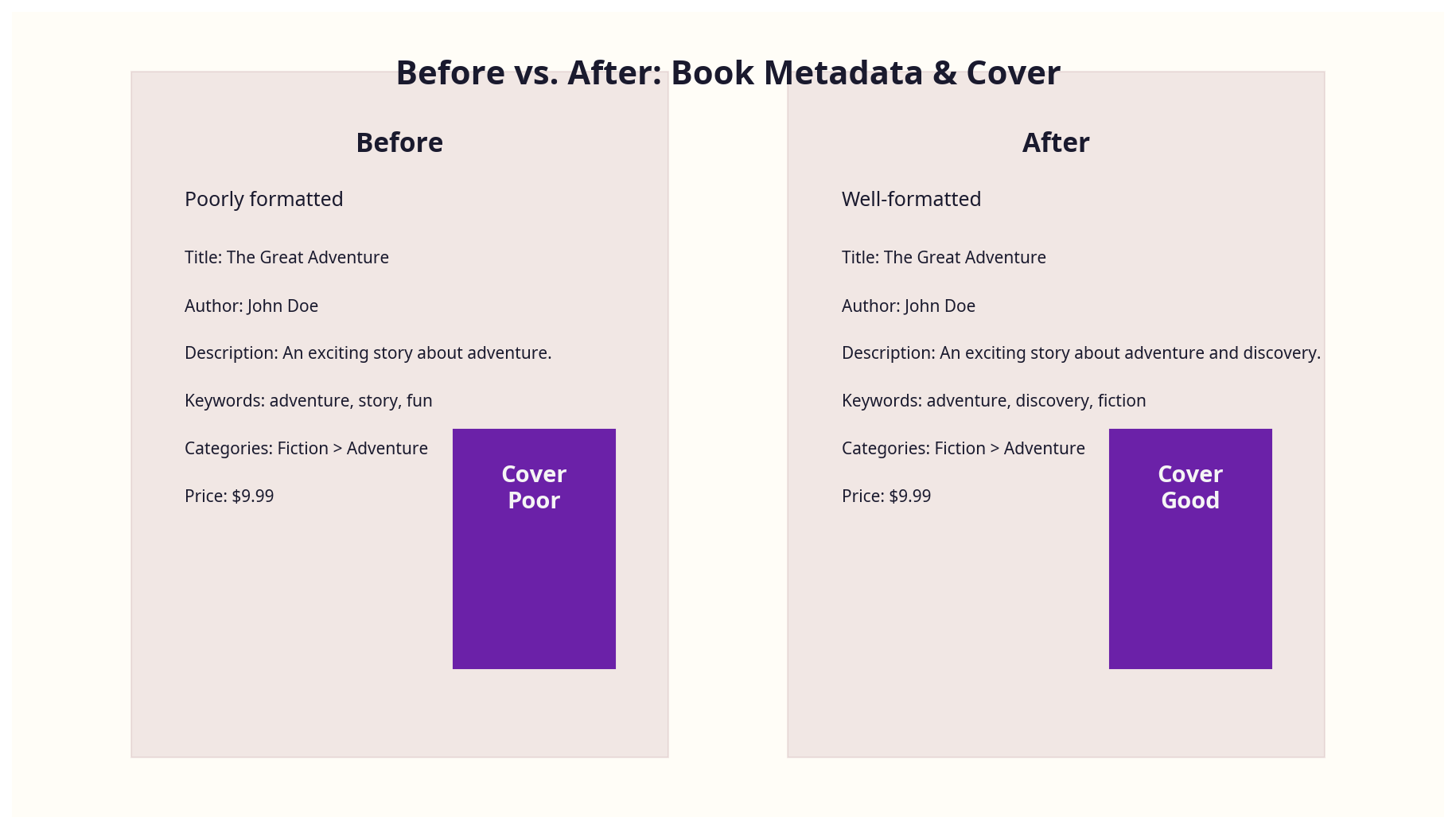
Metadata Optimisation: Poor vs Effective
Tools and Resources for a Smoother Publishing Experience
Formatting Software:
- Microsoft Word: Use Layout > Margins > Custom Margins to set precise print margins.
- Scrivener: Excellent for manuscript organisation and exporting clean ebooks.
- Kindle Create: Free from Amazon, helps create KDP-compatible ebooks with interactive features.
- Calibre: Useful for converting between ebook formats with some manual tweaking.
Cover Design:
- UK professional covers typically cost £300–£600.
- Avoid Fiverr gigs that use stolen or low-quality images; invest in original artwork or photography.
- Services like 99designs UK or local designers often offer better quality and faster turnaround.
ISBN Purchase:
- Nielsen Book Services (nielsenisbnstore.com) is the official UK source.
- Consider buying in blocks to reduce per-ISBN cost.
Tax & VAT Guidance:
- HMRC and the Society of Authors websites provide up-to-date info on royalty taxation and VAT.
- Consult a UK accountant familiar with digital sales if you expect significant income.
Distribution Tracking:
- Draft2Digital’s dashboard consolidates sales across retailers and shows royalties net of VAT.
- KDP Sales Dashboard is Amazon-only but offers detailed reports and sales rank data.
Professional Formatting Services:
- UK authors often find services like publishing.co.uk invaluable for automated KDP-compliant formatting, saving time and avoiding errors. Their tools handle tricky margins, bleed, and file conversions so you don’t waste hours or pay over-the-odds freelancers.
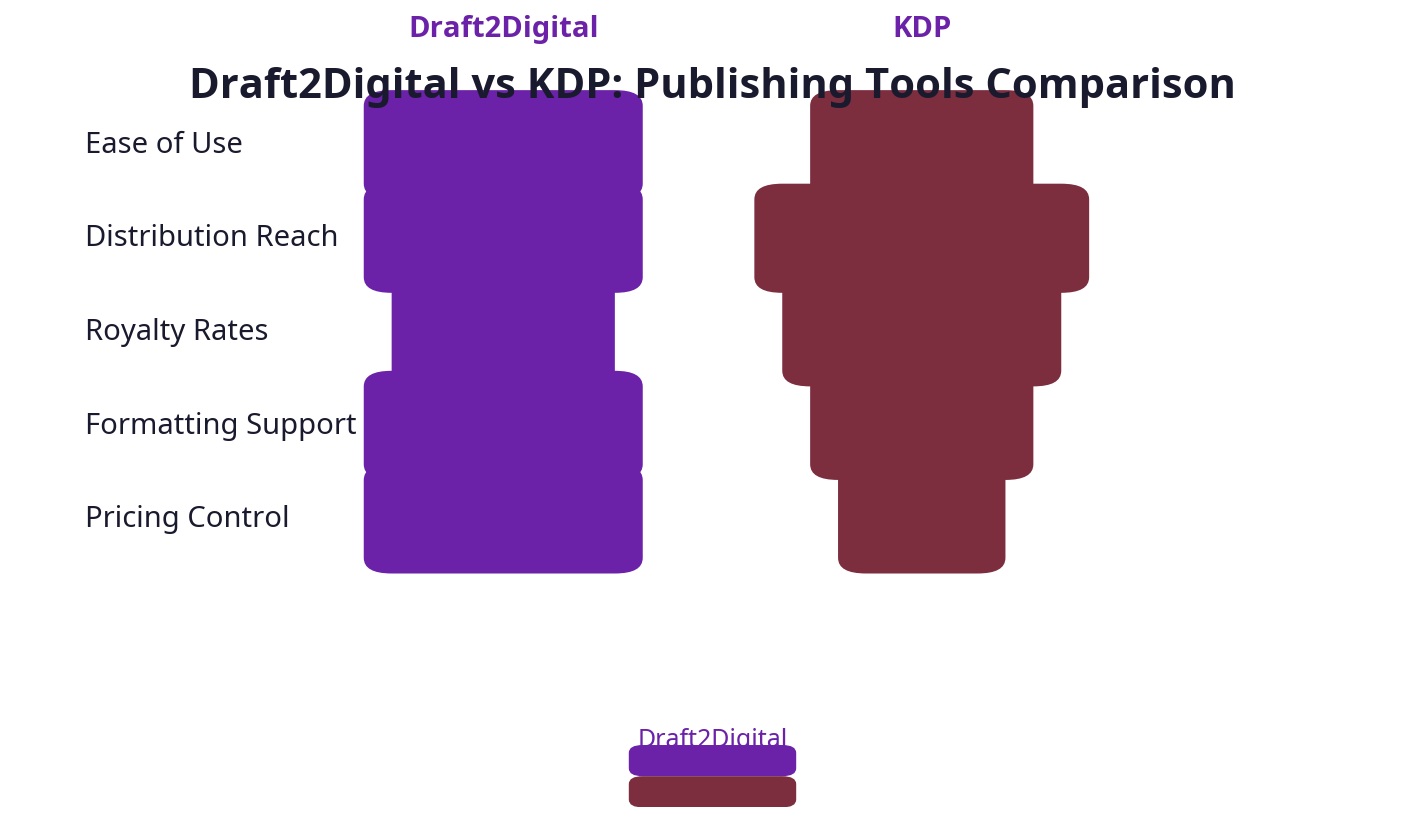
Formatting and Distribution Tools Comparison for UK Authors
Cost Breakdown: Draft2Digital vs KDP in GBP
| Cost Element | KDP (UK) | Draft2Digital (UK) | Notes |
|---|---|---|---|
| ISBN | £93 (Nielsen) or Free (Amazon) | £93 (Nielsen) or Free (D2D) | Free ISBNs assign platform as publisher |
| Ebook Upload Fee | Free | Free | No upfront fees |
| Print Setup Fee | Free | Limited POD, may require extra fees | KDP dominates print POD in UK |
| Royalty Rates (Ebook) | 70% (price £1.99–£7.99) or 35% | 60% net after retailer cut | VAT deducted separately by D2D |
| Royalty Rates (Print) | Approx. 60% minus print costs | Limited print options | Print royalties depend heavily on print cost |
| VAT Handling | Author responsible | Handled by D2D | Important for UK tax compliance |
| Distribution Reach | Amazon only | Multiple retailers + libraries | Wider reach with D2D |
Additional Notes:
- Print-on-demand costs on KDP vary: a 300-page black-and-white paperback costs roughly £2.65 to print.
- Draft2Digital’s print options are less developed in the UK and often routed through US printers, increasing delivery times and costs.
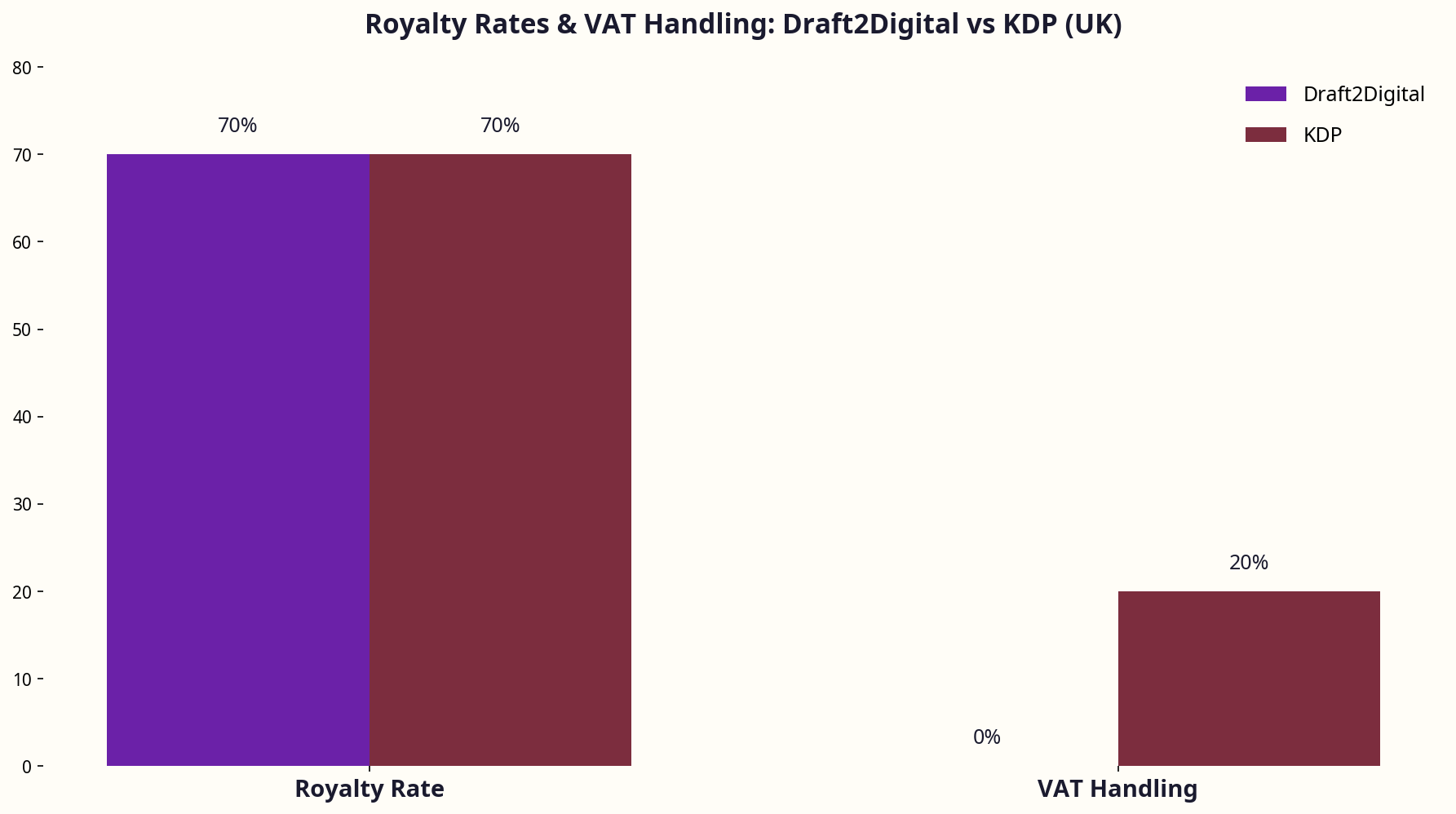
Royalty and VAT Comparison: Draft2Digital vs KDP
UK Market Context and Alternative Approaches
While KDP and Draft2Digital dominate the discussion, UK authors should consider alternative or complementary approaches:
IngramSpark: Print and Global Distribution
- A UK-friendly POD and distribution platform with extensive reach into bookstores and libraries globally.
- ISBNs must be owned by the author, so purchasing from Nielsen applies here too.
- IngramSpark charges setup fees (£39 per title for print and ebook), but offers professional-quality print options.
- Their UK print partners reduce shipping times and costs for British readers.
Hybrid Publishing and Small Presses
- Some UK authors choose to partner with small presses or hybrid publishers, combining professional editorial and marketing with self-publishing flexibility.
- These often provide ISBNs, print distribution, and library stocking support but demand a larger upfront investment.
Direct-to-Consumer Sales
- Selling print and ebooks directly via Shopify or your website bypasses platform cuts but requires marketing muscle and VAT compliance expertise.
- Useful for established authors with a loyal UK readership.
[IMAGE CALLOUT: Infographic showing alternative UK publishing routes including IngramSpark, hybrid publishing, and direct sales]
Alternative Publishing Routes for UK Authors
Real-World UK Case Studies and Examples
Case Study 1: Fiona, a UK Crime Thriller Author
Fiona initially published her ebook exclusively on KDP but struggled with discoverability outside Amazon. After six months, she signed up with Draft2Digital, adding Apple Books and Kobo to her distribution. Her royalties initially dipped due to retailer cuts but stabilised as she gained readers in libraries through OverDrive. She purchased a block of ISBNs from Nielsen upfront, which helped her maintain a consistent brand across platforms.
Key takeaway: Using D2D alongside KDP broadened Fiona’s reach and helped her tap into UK library readers.
Case Study 2: James, a UK Non-Fiction Author
James wanted print copies for local bookstores and libraries. He bought a Nielsen ISBN and uploaded his print-ready PDF to KDP. However, he found KDP’s cover creator too limited, so he hired a UK designer for £500 to produce a professional cover. James priced his ebook at £3.99 to qualify for the 70% royalty rate, factoring in VAT and KDP delivery costs. He avoided free ISBNs to maintain credibility with UK wholesalers.
Key takeaway: Investing in professional covers and ISBNs pays off in credibility and sales opportunities in the UK.
Case Study 3: Sarah, a Debut UK Children’s Author
Sarah tried to use Draft2Digital’s free ISBN but found her book was listed under “Draft2Digital Publishing,” which confused parents and schools. After purchasing her own ISBNs, she re-uploaded her book and gained better acceptance from UK schools and libraries. She used D2D’s library distribution to get her book into UK public libraries, increasing word-of-mouth sales.
Key takeaway: ISBN ownership is essential for educational and library markets in the UK.
[IMAGE CALLOUT: Case study infographic showing sales growth and distribution channels for UK authors using D2D and KDP]
UK Author Case Studies: Distribution and Sales Outcomes
Expert Tips from 25 Years in eCommerce and Self-Publishing
- Own Your ISBNs: Paying £93 for your ISBN is a business investment, not a cost. Free ISBNs mean you’re renting your publishing identity.
- Don’t DIY Your Formatting if You Can Avoid It: I wasted hours wrestling with KDP print margins and EPUB quirks. Automated UK-compliant services like publishing.co.uk saved me weeks and spared me from cowboy freelancers charging over £100 for shoddy work.
- Think Beyond Amazon: KDP dominates UK ebook sales but neglects libraries and some key retailers. Use D2D to complement Amazon, not replace it.
- Metadata Is Your Marketing: Keywords, categories, and descriptions are your first impression. Tailor them per platform; what works on Amazon won’t necessarily work on Apple Books.
- Expect Learning Curves: When I formatted Google. Panic. Repeat., I regularly hit walls with file types and upload errors. Plan for delays and test your files on multiple devices.
- VAT and Pricing Are a Minefield: Always factor VAT into your ebook price on KDP and understand how D2D handles tax to avoid surprises.
- Invest in Professional Covers: A good cover is your best marketing tool. It’s worth spending £300–£600 with a UK designer rather than cutting corners.
- Use UK Trim Sizes and Printing Specs: Stick to common UK sizes like 6” x 9” for print books to ensure compatibility with printers and retailers.
- Leverage Library Distribution: UK public libraries are a significant market. Draft2Digital’s library partners (OverDrive, Bibliotheca) make it easier to get in front of readers.
- Consolidate Reporting with D2D: Managing multiple retailers through D2D’s dashboard saves time and simplifies tax reporting.
Frequently Asked Questions
What is the most common mistake UK authors make with Draft2Digital vs KDP?
The biggest error is relying on free ISBNs from either platform. This limits your control, harms your brand, and can confuse buyers and libraries about who actually publishes your book.
How much does Draft2Digital vs KDP cost in the UK?
Both platforms don’t charge upfront fees for ebook uploads. The real costs come from ISBN purchases (£93 each from Nielsen), print setup if required, and potential formatting or cover design services. Royalties vary: KDP offers up to 70% on ebooks, D2D pays 60% net after retailer cuts.
What tools do UK authors recommend for Draft2Digital vs KDP?
Microsoft Word with custom margin settings for print formatting, Scrivener for manuscript organisation, Kindle Create for ebook formatting, and professional services like publishing.co.uk for automated, clean file prep are top choices.
How long does the Draft2Digital vs KDP process typically take?
From upload to live publication, expect 24-72 hours on KDP. D2D takes longer due to multiple retailers (up to 7 days). Formatting and preparation can add weeks if done manually.
Can I handle Draft2Digital vs KDP myself or should I hire a professional?
If you’re comfortable with file types, formatting, and metadata, you can self-publish. However, many UK authors find the technical barriers steep. Hiring professionals or using automated services like publishing.co.uk is often more cost-effective in time and stress.
What are the UK-specific requirements for Draft2Digital vs KDP?
Key UK-specific needs include purchasing ISBNs from Nielsen, understanding VAT implications, preparing print files in standard UK trim sizes (e.g., 6” x 9”), and considering library distribution, which D2D supports better than KDP.
How do I manage VAT on my ebook sales through KDP and Draft2Digital?
KDP includes VAT in your ebook pricing but doesn’t itemise it for you; you must factor it into your retail price to ensure profitability. Draft2Digital automatically calculates, collects, and remits VAT on your behalf for UK sales, simplifying tax compliance.
Can I use one platform for ebooks and another for print?
Absolutely. Many UK authors use KDP for print-on-demand paperbacks due to its superior UK/EU printing infrastructure and Draft2Digital for ebook distribution beyond Amazon. Just ensure consistent metadata and ISBN usage across platforms.
Publishing is hard enough without battling poor formatting, confusing tax rules, and platform quirks. I’ve lived the frustrations of formatting Google. Panic. Repeat.—from hiring a £130 freelancer who delivered garbage to endless trial and error with KDP’s file requirements. That’s why the UK author community needs clear, practical advice grounded in real experience.
For UK authors looking to publish without losing weeks on technical headaches, platforms like Draft2Digital and KDP each have their place. Knowing their strengths and pitfalls in your market is essential. And when it comes to formatting, the right professional help can make the difference between a nightmare and a smooth launch.
[IMAGE CALLOUT: Tool comparison matrix showing Draft2Digital, KDP, and IngramSpark features for UK authors]
Comparison Matrix: Draft2Digital vs KDP vs IngramSpark for UK Authors
About the Author
Robert Prime is a best-selling self-published author, veteran eCommerce strategist, and the founder of publishing.co.uk. With over 25 years of experience in digital business and 15 successful exits, he brings a battle-tested perspective to the publishing industry. After experiencing firsthand the archaic, headache-inducing process of formatting a KDP-compliant book for his own best-seller, Google. Panic. Repeat., Robert built publishing.co.uk to solve the problem for other authors. He is also a co-owner of the LoveReading.co.uk network (the UK’s largest book review platform), founder of the Amazon growth agency MrPrime.com, and a member of the Forbes Business Council.
This article is regularly updated to reflect the latest UK self-publishing market changes and platform policies.